The Collector's Guide to T206
Everything you need to know to start building your T206 collection — understanding what drives value before you spend a dollar.
In This Guide
Section 1 What Is the T206 Set?
The T206 is a 524-card set issued by the American Tobacco Company between 1909 and 1911 as an insert in cigarette packs. It is widely considered the most prestigious vintage card set in the hobby — sometimes called the "Monster Set" because of the scope and difficulty of completing it.
The set features nearly every professional baseball player of the era, from superstars like Honus Wagner and Ty Cobb to obscure minor leaguers who otherwise would have been lost to history. This breadth is part of what makes T206 so compelling: there is a card for every budget and every level of collector.
Section 2 The Hall of Fame Players That Drive the Market
While the T206 set has 524 cards, a handful of Hall of Fame players represent the majority of the market's attention and dollar volume.
Section 3 The Back Variable — Why the Same Card Can Have a 100× Difference in Value
This is the most important concept in T206 collecting. The front of the card shows the player; the back shows a tobacco brand advertisement. The card was produced in multiple "series" and distributed by many different brands, meaning the same exact player photo was printed with dozens of different backs.
A Ty Cobb card with a standard Piedmont back might sell for $3,000 in PSA 3. The same pose with the rare Ty Cobb Back might sell for $300,000. That is a 100× difference — for the same card.
There are 16 different T206 cigarette brand backs. In alphabetical order: American Beauty, Broad Leaf, Carolina Brights, Cycle, Drum, El Principe De Gales, Hindu, Lenox, Old Mill, Piedmont, Polar Bear, Sovereign, Sweet Caporal, Tolstoi, Ty Cobb, and Uzit. The backs range from common to ultra-rare. Photos of each of these backs are below.
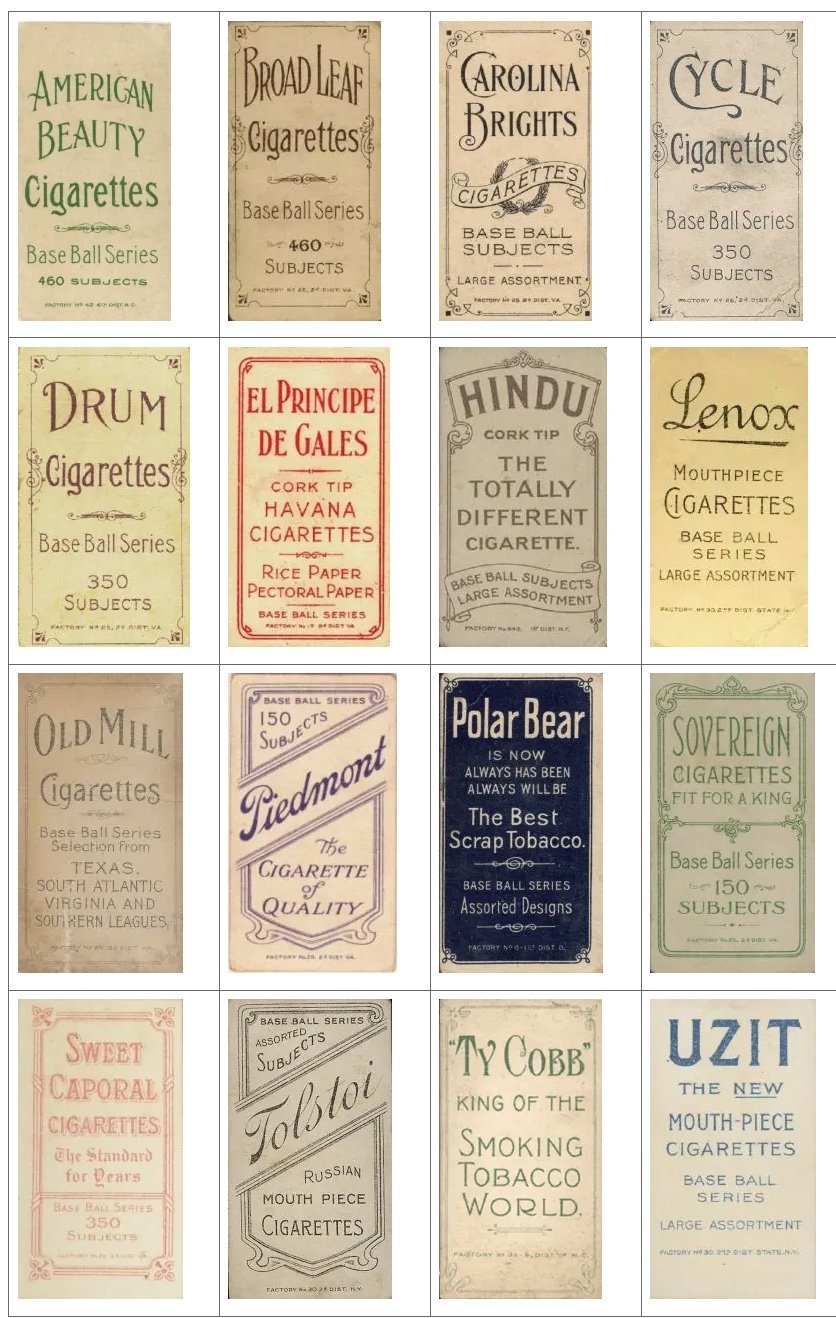
A selection of T206 back variations — the same front image carries dramatically different values depending on what's printed on the reverse.
| Back Type | Rarity Tier | Multiplier | Market Context |
|---|---|---|---|
| Ty Cobb Back · Uzit · Lenox (Brown) | Ultra-Rare | 100×–130× | Museum-quality assets. The Ty Cobb Back and Uzit sit at 100×; Lenox Brown reaches 130×. Rarely surface at public auction. |
| Broad Leaf (Ser. 350 & 460) · Hindu (Red) · Drum · Lenox (Black) | Extremely Rare | 25×–50× | Set-builders spend years hunting these. Broad Leaf 460 sits near 50×; Lenox Black at 25×. Any example is a significant find. |
| Carolina Brights · Hindu (Brown) · Blank Back · Cycle (Ser. 460) | Scarce | 8×–18× | Major value premium over common backs. Carolina Brights at 18×, Hindu Brown at 9×. High appreciation potential in mid-grades. |
| American Beauty · Cycle (Ser. 350) · Tolstoi · El Principe de Gales · Sovereign (Ser. 460) · Piedmont (Fac. 42) | Uncommon | 2.5×–4.5× | The "Goldilocks" zone — meaningfully rare but still findable at auction. American Beauty 460 at 4.5×; most others in the 2.5×–3× range. |
| Polar Bear · Old Mill · Sovereign (Ser. 150/350) · Sweet Caporal Overprint | Common+ | 1.3×–1.5× | Accessible premium. A great entry point for collectors stepping beyond Piedmont without a large cost increase. |
| Piedmont · Sweet Caporal (standard) | Common | 1.0× | The baseline for all T206 valuations. The most common backs — and the best starting point for new collectors. |
See the full list of all 38 T206 back variations with exact multipliers on the Back Scarcity Guide →.
Section 4 Back Rarity by the Numbers — PSA Population Data
The tier labels above aren't just relative — the PSA census gives us hard numbers. Out of 244,403 T206 cards certified by PSA, here is how the population breaks down by back type. The dominance of Piedmont and Sweet Caporal is striking, and the drop-off toward the rare backs is steep.
| Back | PSA Certified | % of Total |
|---|---|---|
| Piedmont (all, excl. Factory 42) | 126,306 | 51.68% |
| Piedmont 350/460 Factory 42 | 431 | 0.18% |
| Sweet Caporal | 67,937 | 27.80% |
| Old Mill | 12,209 | 5.00% |
| Polar Bear | 11,744 | 4.81% |
| Sovereign | 10,474 | 4.29% |
| El Principe de Gales | 3,513 | 1.44% |
| Tolstoi | 2,902 | 1.19% |
| American Beauty | 2,639 | 1.08% |
| Cycle | 2,473 | 1.01% |
| Hindu Brown | 1,634 | 0.67% |
| Hindu Red | 219 | 0.09% |
| Carolina Brights | 744 | 0.30% |
| Broad Leaf 350 | 420 | 0.17% |
| Broad Leaf 460 | 52 | 0.02% |
| Lenox Black | 298 | 0.12% |
| Lenox Brown | 28 | 0.01% |
| Uzit | 180 | 0.07% |
| Drum | 176 | 0.07% |
| Ty Cobb Back | 21 | 0.01% |
| Total | 244,400 |
Source: PSA certified population (Grade + Grade+ + Qualifier totals per back). Italicized rows are sub-variations. Data as of March 2026.
Section 5 Grade vs. Price — The Sweet Spot
T206 cards are 115 years old. Unlike modern cards where PSA 9–10 represents the bulk of value, the T206 market rewards collectors who understand the grade curve specific to vintage cards.
| PSA Grade | Market Reality | Recommendation |
|---|---|---|
| PSA 1 (Poor) | Liquid and accessible — easiest cards to find and buy. Limited appreciation potential for commons. For The Big 6, often the only realistic way in. | Entry Level |
| PSA 1.5 – 2 (Fair–Good) | Right for collectors who want an authenticated HOF example without stretching the budget. Look for solid eye appeal — cards where a back stain or paper flaw dinged the grade but the front presents cleanly offer strong value. | Starter |
| PSA 3 – 4 (VG–VG-EX) | The sweet spot for T206. Cards show clear imagery, most details intact, and represent the best balance of affordability and future appreciation potential. | Best Value |
| PSA 5 – 6 (EX–EX-MT) | Solid investment grade. The price curve gets steeper here but cards present extremely well. Institutional-quality HOF names in this range. | Strong |
| PSA 7 – 8 (NM–NM-MT) | Exceptional for the age of these cards. Pricey but market is liquid and stable. Tightly held by advanced collectors. | Premium |
| PSA 9 – 10 (MT–Gem Mint) | Effectively unobtainable. Only 13 PSA 10 T206 cards exist across the entire set. PSA 9 examples are nearly as scarce — only ~320 exist total — and even commons command serious money. The last known PSA 9 sale was a Nap Lajoie Throwing that sold for $54,000 in 2025. No PSA 9 Wagner exists. | Unobtainable |
Section 6 Avoiding Fakes & Reprints
The T206 market has been flooded with reprints and altered cards since the 1970s. Many reprints are sold honestly as reprints, but they regularly find their way onto eBay described as originals. Here is the 30-second checklist. For a deeper visual guide, see How to Spot a Fake T206 Card →
- Check the paper stock. Authentic T206s have a distinct, soft, slightly brittle texture from century-old paper. Modern reprints feel like uniform cardboard with no tooth.
- Look at the print quality. Original T206s used lithographic printing — look for subtle dot patterns under magnification. Modern reprints often have sharper, more uniform color.
- Examine the back carefully. Reprints frequently use incorrect ink colors, fonts, or text spacing on the tobacco advertisement. The back is often where fakes are easiest to spot.
- Verify any PSA holder authenticity. Buy only PSA- or SGC-graded cards for any meaningful purchase. Verify the cert number at PSA's website before buying raw cards above $100.
- Be suspicious of deals that defy gravity. A "PSA 5 Wagner" for $5,000 is not a deal — it is either a fake, a trimmed card, or a cert that has been tampered with.
Section 7 Where to Start
Now that you understand the basics, here are the tools on this site that will help you collect smarter: