I've been in this hobby for over two decades. I've handled thousands of cards across dozens of sets, watched markets rise and crash, seen fads burn hot and fizzle out. Tobacco cards, prewar, postwar, modern — I've touched most of it. Nothing compares to T206. Not close.
What Makes T206 Special
The American Tobacco Company issued T206 cards from 1909 to 1911, tucked inside cigarette packs as promotional premiums. They weren't designed to be collectibles — they were advertising inserts. Meant to be flipped, traded by kids, and forgotten.
The fact that any survived 115 years is remarkable. The fact that they're now selling for millions is a true testament to the scarcity, beauty and history of the set.
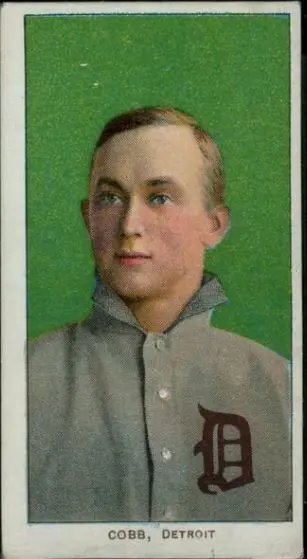 T206 Green Portrait Ty Cobb Card
The set contains approximately 524 cards — though that number is debated depending on how you count certain variations and errors. Around 388 unique players are represented, with some appearing in multiple poses. More than 70 cards are of players now enshrined in Cooperstown.
Fifteen undisputed advertising backs were used — with potentially two more depending on how you classify the Ty Cobb and Coupon brands — meaning the same player card can exist with a Piedmont back, a Sweet Caporal back, a Polar Bear back, and so on.
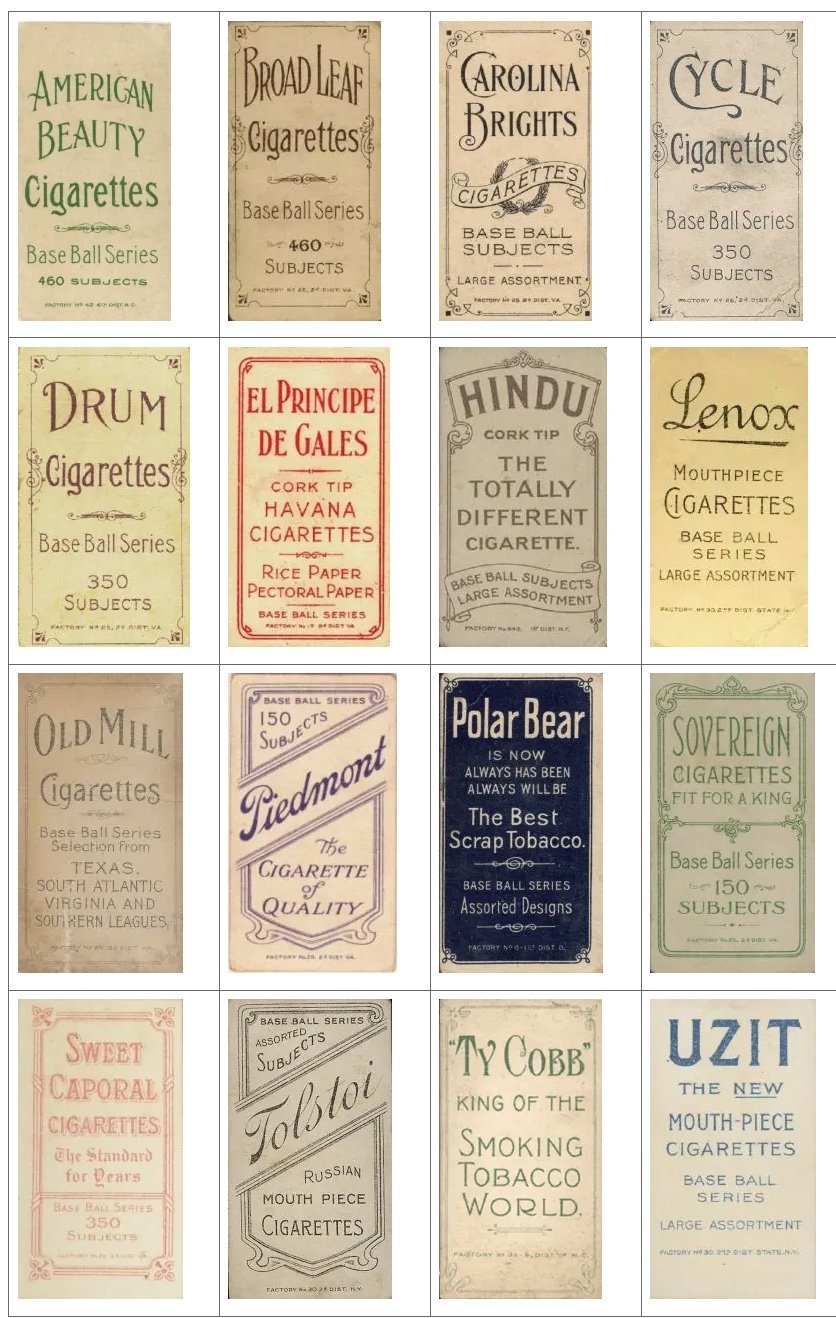 T206 Advertising Backs
Completing even a single-back run is a serious undertaking. Completing a master set with all backs is, practically speaking, impossible.
The Rule Breakers: Six Cards That Defy Classification
Every serious T206 collector knows the Rule Breakers — often called "The Big Six.", both terms affectionately coined in Scott Reader's T206 Bible (a highly recommended read). These aren't just the most valuable cards in the set.
They're the ones that define the framework for the most important set in the history of baseball cards, each scarce for a distinct and specific reason. Understand these six and you understand what separates a knowledgeable T206 collector from everyone else.
Honus Wagner
Between 50 and 75 known examples exist. Total. The entire world supply. Most are in rough shape — torn, trimmed, heavily worn. Finding a clean, unaltered example even in lower grade is extraordinarily rare. Note PSA has graded 37 and SGC only 6 for a total of 43 graded copies.
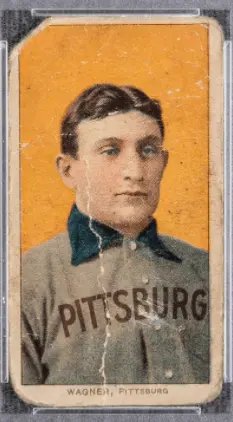 T206 Honus Wagner Card, The Holy Grail Of The Hobby
The most recent high-profile sale was a PSA 1 copy that sold for $5.1 Million. Why is the Wagner so hard to find? Wagner reportedly objected to his likeness being used in cigarette advertising — whether the motivation was anti-smoking conviction or lack of compensation is still debated — and had production stopped early. Over time, the combination of scarcity, and Wagner's status as an elite HOF player has led to the card being recognized as the crown jewel of American sports collecting.
Eddie Plank
Plank is one of T206's genuine unsolved mysteries. The commonly cited "broken printing plate" theory doesn't hold up under scrutiny — Plank has been confirmed with both 150 series and 350 series backs, spanning multiple production runs years apart. A broken plate can't explain that.
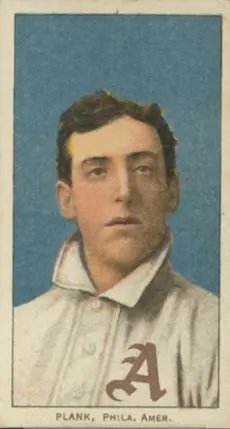 Eddie Plank T206 Card, one of the rarest in the set.
Fewer than 100 examples are thought to survive, possibly as few as 75. Nobody knows with certainty why the card is so scarce, thus the Plank remains one of the sets true mysteries. Any legitimate copy in any grade is a significant find.
Joe Doyle (NY Nat'l)
This is the one that trips up newer collectors — and comes with one of the hobby's great stories. Doyle was a Yankees pitcher, and most of his cards read "NY Amer." correctly. But early in the 350 series print run, a small number were printed reading "NY Nat'l" — mistakenly identifying him as a Giants player. The error was caught fast, and very few of the Nat'l version were issued. Only about seven or eight examples are known to exist, and several years can pass between public sales.
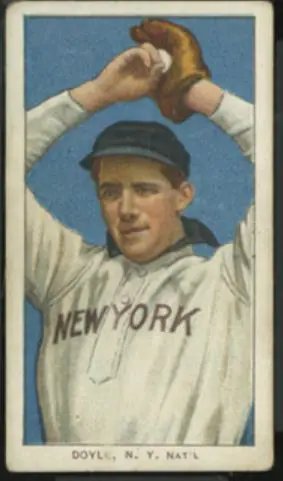 Joe Doyle T206 Error Card, one of the rarest in the set.
The backstory adds to the mystique: in 1981, Wisconsin dealer Larry Fritsch discovered the Nat'l variation while assembling a Giants team set. He ran ads offering double the going rate for any Doyle card, collected hundreds of the common Amer. version — none of the Nat'l — then sold the lot to a buyer from Flint, Michigan who had, unbeknownst to Fritsch, planned to doctor them into Nat'l cards. The man was reportedly arrested. The fate of that hoard of Doyle cards is still unknown.
Sherry Magie
Sherry Magee was one of the better hitters of the Deadball Era — top ten in the National League in slugging eleven different seasons. His portrait card was initially released with his name misspelled as "Magie."
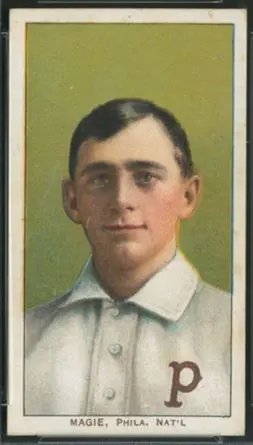 Sherry 'Magie' T206 Error Card, one of the rarest in the set.
The error was caught and corrected quickly, which is why the misspelled version has only ever been confirmed with the Piedmont 150 back — consistent with the correction happening very early in the 150 series print run. Somewhere between 100 and 200 examples are thought to survive. It's the kind of card that turns up in old collections and surprises people who don't know what they're looking at.
Demmitt (St. Louis)
Ray Demmitt was traded from the New York Highlanders to the St. Louis Browns in December 1909. His common card shows him as a Highlander. But Factory 6 in Ohio — the sole distributor of Polar Bear-backed T206 cards — updated his artwork and team caption to reflect the trade.
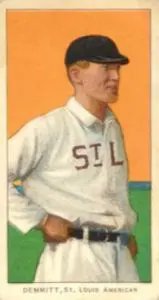 Ray Demmitt T206 St Louis Error Card
The result: Demmitt (St. Louis) exists only with the Polar Bear back, making it entirely a product of one factory's late-run update. An estimated 200 to 400 copies survive. Polar Bear cards were distributed in scrap tobacco pouches rather than cigarette boxes, which is why they often exhibit significant tobacco staining — finding a clean, high-grade example is genuinely difficult.
O'Hara (St. Louis)
The story behind O'Hara (St. Louis) mirrors Demmitt almost exactly. Bill O'Hara played outfield for the New York Giants in 1909 and was traded to the St. Louis Cardinals for 1910. Factory 6 in Ohio alone updated the artwork — same late-run Polar Bear situation.
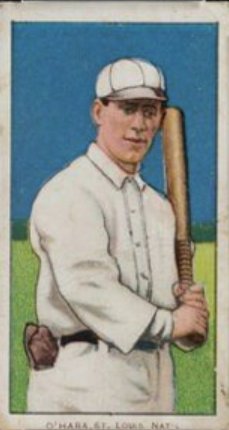 Bill O'Hara St Louis Error Card
The card exists only with the Polar Bear back, with a similar estimated population of 200 to 400 surviving examples. These two cards are often overlooked by newer collectors who have only heard about the "Big Four" — but any honest accounting of T206's rarest cards includes all of the 'Big Six'.
Note: Other top name HOF players like Ty Cobb, Cy Young and Walter Johnson are among the most desirable players in the set — but their desirability is driven by player demand and in Cobb's case a special advertising back variation, not the same kind of extreme production scarcity that defines the "Big 6" above.
"A master set — every player on every known back — is more of a theoretical exercise than a realistic goal. Most serious collectors pick a lane. That's not a compromise. That's the only sane way to approach it."
The Backs: Where Collecting Gets Complicated
This is where T206 really separates itself from every other set. Because the same player appears across multiple advertising backs, serious collectors have to decide early on what they're actually trying to build.
Multipliers relative to Piedmont baseline. 38 distinct back variations when factory and series are counted separately.
There are 15 undisputed advertising brands — 38 distinct back variations when you account for factory, district, and series. Most collectors don't fully appreciate this until they've been in the hobby a while, and it's the single biggest source of mispricing and confusion in the T206 market.
Common Tier: At the baseline are Piedmont and Sweet Caporal in their standard varieties.
Common+ Tier One step up are the Common+ backs: Polar Bear, Old Mill, and Sovereign 150/350. These carry a modest 1.3× premium — more for their visual character than dramatic scarcity. A solid stepping stone for collectors looking to move beyond standard backs without a major premium jump.
Uncommon Tier: — Cycle 350, Tolstoi, El Principe de Gales, Old Mill Southern League, Sovereign 460 — runs 2.5–3×. Meaningfully rare but still findable at auction with patience. The "Goldilocks zone" for collectors building appreciating value into a set without chasing impossible cards.
Scarce Tier:, where things get serious. Hindu Brown, Carolina Brights, American Beauty, and Cycle 460 command 4.5–6×. American Beauty in particular is commonly misunderstood as approachable — it isn't. These backs represent a meaningful jump in both value and difficulty that surprises collectors who aren't tracking multipliers.
Extremely Rare Tier:Broad Leaf, Lenox (Black and Brown), and Red Hindu are Extremely Rare at 15–20×. Set-builders hunting these can spend years between opportunities. Red Hindu especially is underestimated by newer collectors who see "Hindu" and assume it's comparable to the Brown version. It isn't — it's more than three times scarcer.
Top Tier:At the top sit Drum (30×), Uzit (25×), and the Ty Cobb Back (100×) — institutional-grade rarities that rarely appear in public auctions. The Ty Cobb Back is in a category entirely its own: a separate advertising brand featuring Cobb's likeness, distributed from Factory 33 in North Carolina, with about a dozen known examples. On a per-card basis it may be the most valuable back in the entire set.
Knowing where a back falls in this hierarchy is important when buying T206 cards.
Condition: Why Grading Matters More Here Than Almost Anywhere
T206 cards were printed on relatively thick card stock — sturdier than many contemporaries, which goes a long way toward explaining their survival rate after 115 years. That said, the printing technology of 1909 wasn't precise. Centering was inconsistent from day one, and cards spent decades being handled, traded, and stuffed into shoeboxes.
Tobacco residue, paper loss, edge wear, creases — it's all common. The cards lived in cigarette packs alongside the cigarettes themselves, and a century of that kind of cohabitation leaves marks. Finding a clean copy is harder than it sounds, but the sturdiness of the T206 cards definitely helped.
The grading gap and corresponding value in T206 cards however can be quite significant. A common player in a PSA 1 or 2 grade might sell for $75-$100 The same card in PSA 8 could bring several thousand. The jump from Poor or Good to to EX to EX-MT is massive.
PSA and SGC population reports are essential reading before any serious purchase. You need to know how many examples exist in each grade. That data is publicly available and should inform every buying decision you make in this set.
The Investment Case
Having watched this market for twenty-plus years: T206 is one of the few sets that has consistently justified a long-term holding.
The supply is fixed. Production ended in 1911. Every card that exists today is all that will ever exist, and that number only goes down over time as cards are lost, damaged, or permanently locked away. Of course as each year goes by, the number of 'new to hobby' discoveries will dwindle, which makes our supply even more finite.
Demand has grown steadily as the hobby has matured and as wealth has flowed into alternative assets. The auction record for a Wagner will continue to be broken into the future.
If you're new to the T206 set, I encourage you to consume as much information as you can about the set, and get up to speed on pricing for not only specific players, but the differences between the common and rare back pricing. Use the eye test to find cards that look better than their actual grade. After a while, you'll become as hooked as ever and realize the allure of the T206 Monster.
Getting Started
Don't start with the "Big Six". Don't even think about them yet. Start with a Hall of Famer you care about in a grade you can afford — PSA 3 or 4, a back you like the look of.
Learn the population reports before you spend real money. Understand what back variations command premiums and why. The data is free and publicly available — use it.
Buy only authenticated examples from reputable dealers or established auction houses. Counterfeits exist, they've gotten better, and they're not always obvious.
The T206 Society and various collector communities are worth your time. The collectors who've been doing this for thirty years have seen things you haven't, and most of them are willing to share what they know.
Think long-term. If you're looking for a quick flip in six months, you're in the wrong part of the hobby. If you're building something over years and decades — something that holds real historical and financial value — there's nothing better.
These are 115-year-old artifacts from baseball's foundational era. The players on these cards built the sport. And there are only so many of them left.
Leave a Comment
Join the Discussion